
We Surveyed 100 Leaders.
Here's What We Found.
When we share that mangers waste 3.5 hours a day due to flawed work systems, it grabs attention. Here's what the initial data actually shows, why the variance is the most interesting part, and how to find your own number right now.
When we shared this finding, the reactions split. Some leaders said "that feels low." Others pushed back: "there's no way that's right."
Both reactions make sense. Because the most important thing about this number is not the average. It's the range.
Understanding the dataThe Average Hides the Story.
Our sample shows enormous variance. Think of the distribution as bimodal or U-shaped rather than normally distributed. Respondents do not cluster near the mean., but rather on ends. The distribution looks more like this:
Range of Daily Waste Across 100 Leaders
Some of this variance is explained based on their role. There is a correlation between how long someone has been a manger or in their leadership role and the about of time wasted on flawed work systems, indicating that more experienced employees are taking on responsibility for system work arounds. This relationship and the overall range of responses is why we're expanding the study. Developing benchmarks segmented by industry, company size, and leadership level to tell you something actionable.
Five Categories. One Very Long Day.
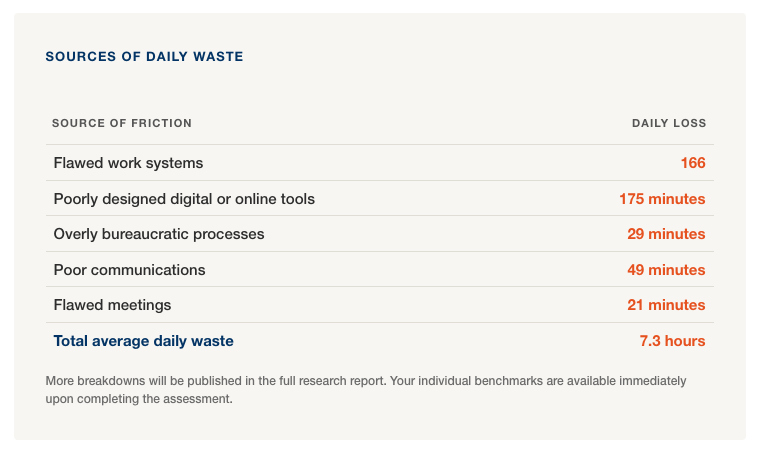
In our initial sample, we asked respondents to estimate how many times a day they had to solve or work around flawed work systems and how much time you waste when you have to work around or solve a flawed work system. Since then we added other problems that waste time for comparison. Here are other categories compare based on 2026 responses so far.
Sources of Daily Waste
| Source of Friction | Daily Loss |
|---|---|
| Flawed work systems | 166 |
| Poorly designed digital or online tools | 175 minutes |
| Overly bureaucratic processes | 29 minutes |
| Poor communications | 49 minutes |
| Flawed meetings | 21 minutes |
| Total average daily waste | 7.3 hours |
More breakdowns will be published in the full research report. Your individual benchmarks are available immediately upon completing the assessment.
Flawed Systems Don't Just Waste Time. They Undermine Whatever You're Trying to Build.
Every leader we work with is trying to accomplish something: grow revenue, launch a new product, improve retention, enter a new market, improve quality, build a stronger culture. I could go on on and on, but my point is even as the strategies differ, the constraint is almost always the same.
When your systems are broken, your people spend their energy working around them instead of advancing your priorities. When your people are consumed by friction, the work that actually drives your strategy gets compressed into whatever hours the system leaves behind. That's true whether your goal is innovation, operational excellence, customer experience, or growth.
Broken systems don't just slow you down. They create a psychological barrier on what's possible regardless of how good your strategy is or how talented your team is. And because the friction is normalized over time, fear is higher, confidence is lower and most leaders don't know if it is getting better or worse because they don't measure it.
What we're buildingThe Research Is Still Open. Your Data Point Matters.
The 3.5-hour average comes from our first study of 100 managers back in 2024. We're expanding the study across industries, company sizes, and leadership levels to build benchmarks that are more useful. The goal is standardize a method for measuring flawed work systems and generate quantitative insights on the impacts flawed work systems have your culture and your ability to achieve your strategic mission.
The full findings will be published in a future report and shared with everyone who participates. But you don't have to wait. The assessment gives you your personalized results and benchmarks the moment you complete it.
It takes about seven minutes. You'll know your number before you close the tab.
Find Out How Much Time Your Organization Is Losing
Answer 40 questions. Get your personalized benchmark instantly, including how your waste, readiness, and culture scores compare to other leaders.
Take the Assessment → Free · ~7 minutes · Instant results · No login requiredThe Eureka! Leadership Research Study is ongoing. Full results will be shared in an upcoming report and newsletter. Questions? Reach us at eurekaranch.com/contact.