
People vs. Process
Does it matter how your people think?
I've heard leaders say that they don't think their people are creative enough to solve the challenge they are up against. And given the opportunity we prove them wrong everytime. Follow the Innovation Engineering process and it will produce ideas, from anyone, in any role, on any team. We've seen it happen too many times to argue otherwise.
But to be fair if you give a room full of people the exact same process, and they don't produce it equally. The reality is while it works and everyone will invent something, so people will invent a lot more than others. So Greg Lemmon pulled the data from a recent session and here is what he learned and why it matters less than you'd think.
One Session, 48 People
We ran a create session with 48 participants. Beforehand, everyone completed a pre-assessment covering readiness to create, readiness to execute, and thinking style. During the session, ideas went into our online portal, Jump Start Your Brain, which let us line up what people actually produced against how they self assesed going in.
Our process typically produces about one idea per exercise per person. This time, individual total for the day ranged from 1 idea all the way up to 12, averaging 4.8. That's more spread than we usually see, so we went looking for who landed on the high end and who landed on the low end.
Thinking Style Matters, Just Not as Much as You'd Guess
Whether someone skews left brain or right brain didn't decide how many ideas they submitted. You need traits from both sides regardless. What did move the needle, slightly, was more specific: people who called themselves spontaneous rather than predictable, or more visionary than logical, submitted a bit more. People who leaned more people-oriented than process-oriented submitted a bit less.
Rational versus emotional turned out to be a complete non-factor. Our hypothesis is that traits like trusting your gut and being spontaneously align with less fear of being wrong and more willing to submit ideas. Similarly process oriented people are probably more likely follow the process when we say to submit an idea rather than just talk about it with their group.
Low Respect for Leadership
This one actually surprised us. People who reported lower respect for senior leadership submitted more ideas: 6.25 on average, versus 4.5 for everyone else. Of every question on the assessment, this was the single most predictive one.
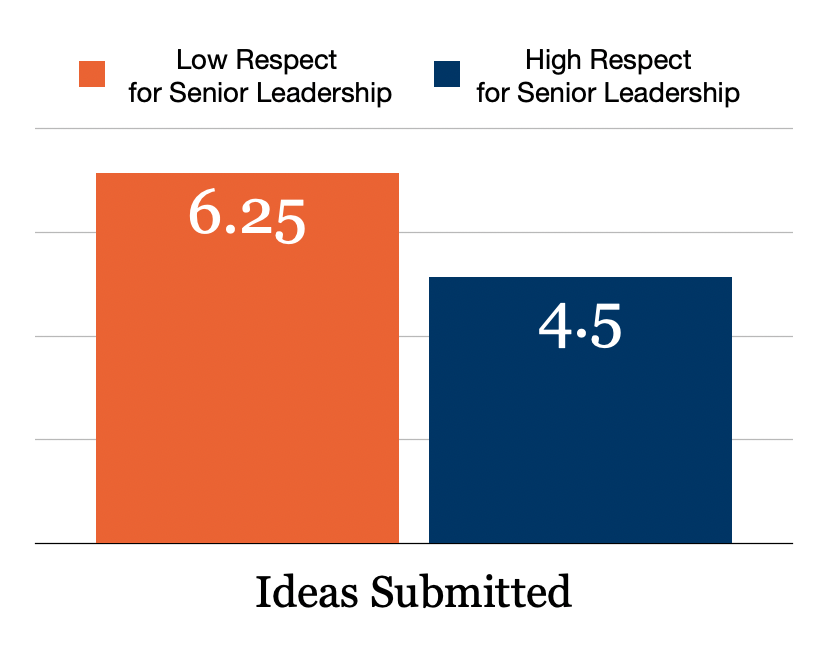
Without jumping to conclusions or speculating too much, my hypothesis is that this session gave a few people from fear-heavy, change-averse leadership environments a rare outlet to finally say what they'd been sitting on. Or, maybe they're just more honest. If you're willing to answer the respect for leadership question honestly, I doubt you'll have a problem sharing your ideas.
Trust the Process
It's genuinely fun to dig into data like this. But at the end of the day, the session itself was a success, and that's worth remembering before you start second-guessing a few less engaged people in the room. Some of what drives output is simply out of your control.
Never skip the pre-assessment. It won't change how many ideas someone submits, but it lets you manage expectations and meet people where they actually are, instead of where you assumed they'd be.
What you can control is the size and makeup of the room. Add more people, and diversity gets easier almost automatically. Keep the group small, and a lack of diversity becomes far more likely. We also recommend putting a trained facilitator at every table, so the room stays spontaneous while inventing, and stays disciplined enough that everyone is actually writing when it's time to submit.
Continuous improvement. We've been running create sessions for close to 40 years. The key to our success is collecting data, thinking about it like a system (separating our common cause vs special cause variance) and making improvements before running the next one. Whatever work you're doing right now, ask yourself if you're tracking the right data. Not so you can overanalyze it, just so the next time you try it, you're a little smarter than the last and you know if you're getting better or worse. That mindset applies just as well to something as fuzzy as thinking style and inventing as it does to almost anything else you do.
The number of ideas invented isn't the most important metric from a create session. The alignment gained from assmebling a team to invent ideas for a shared future is more valuable than the ideas themselves. Plus it is a great way to drive Employee Engagement. This is why we often do a create session as part of the Eureka! Flywheel, so we build alignment and engagment along with jumpstarting some momentum.