The Uniqueness Penalty
Word of mouth is the most trusted growth engine there is, and meaningful uniqueness is what lights it. But communicating truly unique ideas is easier said than done.
How We Know Word of Mouth Works
Back when we first started researching word of mouth, most of our clients wanted the same thing: awareness, without paying full price for it through traditional media. It was also the era when "going viral" got talked about, seriously, as an actual marketing strategy. Nielsen's global trust study from that time backed up the instinct: 92% of people said they trust recommendations from someone they know above every other form of advertising, and 70% trusted opinions from strangers online. Traditional paid ads never cleared 50% trust in the same study (Nielsen, 2012).
Word of mouth research has only gotten more sophisticated since then. We now know its effectiveness is shaped by industry factors, by demographic characteristics, and by how involved the consumer actually is with the product or category. But the core mechanics haven't changed. People trust people they know more than they trust ads. And we know what actually causes people to talk in the first place: a meaningfully unique offering. Word of mouth really starts to take off once an idea scores above a 7 out of 10 on a 0 to 10 scale for overall appeal. Uniqueness is what gets people talking. Meaningfulness is what makes it relevant enough to actually drive a purchase.
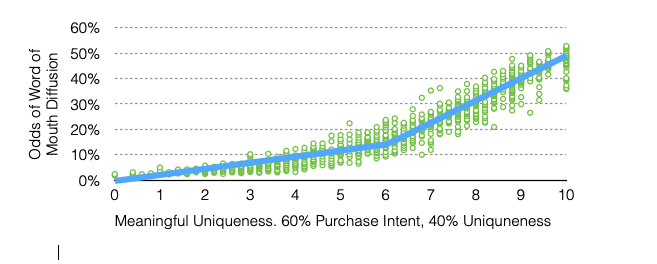
Knowing this has always left leaders with two real paths for igniting it. You can buy it, paying for influencer marketing to rent someone else's audience. That's usually the move when the product isn't quite great and you need sales fast, and it works right up until you stop paying for it. Or you can earn it, by building something genuinely wow and letting word of mouth do the marketing for you. That path takes longer, but it saves marketing spend up front and tends to produce better profits, as long as the offering can't be easily copied.
Without getting too far into the weeds, the practical takeaway still holds up: ask your customers for referrals and reviews, and make it easy for them to talk about what you offer. And since we're on the subject: if this post is useful consider sharing it help our word of mouth marketing 😉
So we're all on the same page. Word of mouth works, and meaningful uniqueness is what fuels it. Here's the part nobody warns you about: actually communicating a meaningfully unique idea is hard.
Meaningfully Unique Ideas Are Harder to Explain
Take our Brain Brew Custom Bourbon Experience. For two hours, guests learn about bourbon, then blend different combinations that change distinct dimensions of flavor and experience: smoke, complexity, aftertaste, sweetness, and more. Before they leave, they can buy a bottle of their own recipe with their own name on the label.
I just wrote a few sentences to describe it. Now imagine trying to pass that along to the next person, in a normal conversation, from memory.
That's exactly what happened. People kept asking us for a tasting event to try our bourbons, while we were actually trying to sell them their own bourbon. The concept itself tested beautifully, a full point higher than our top-selling bottle on that same 0 to 10 scale. It just had a communication problem, and that problem got even harder the moment we tried to explain it in an online ad with 30 characters and a single image to work with.
Three Strategies to Communicate a Radical Idea
It took us several iterations to find language that people actually understood and could pass along on their own. Here are 3 things to consider.
Anchor a new concept to something familiar. We tried framing it as "Build-A-Bear for Bourbon." Instantly, people had a mental model for what they'd actually be doing: choosing, customizing, walking out with something personal, not just picking a bottle off a shelf. This worked well with people who got it and a step in the right direction, but we didn't stop there.
Stop describing the product and describe the job it does. Controlling the exact about of smoke or oak flavor in your bourbon is a very unique feature. The benefit was ultimately a really fun experience. This also lead to more successful campaigns targeting the spouses of bourbon drinkers.
Pick the one attribute of the category you disrupt, and contrast it head-on. Every bottle on a liquor store shelf was made for everyone. This one was made for you. That contrast became a line we kept coming back to and still say today:
"The world doesn't need another bourbon. Everyone needs their own."
When you're working on an idea that scores above a 7 on uniqueness, don't underestimate the communication challenge, but also trust the Innovation Engineering system. With enough cycles you'll find the right combinations of words that are repeatable without watering down your message.
Inventing a meaningfully unique offering is only part of what we do. We also build the communication tools that drive clarity, test ideas with real customers fast, and repeat that cycle until the language finally clicks. Happy to chat about it.