
Every Generation Is Disengaged at Work. Here Is Why That Is a Systems Problem.
It is not the young people. It is not the old people. The data shows every generation is disengaged right now. And the reason is not who they are. It is the systems they are working in.
There is a conversation that happens in a lot of leadership meetings. Someone raises the engagement problem and then immediately qualifies it. "Well, you know how those younger employees are." Or, "The older folks just do not want to adapt." I hear it constantly. And the data says both of those explanations are wrong.
Do not turn around and say we have a culture of engagement, except for those young people or those old people. Every single generation is disengaged. The data is clear.
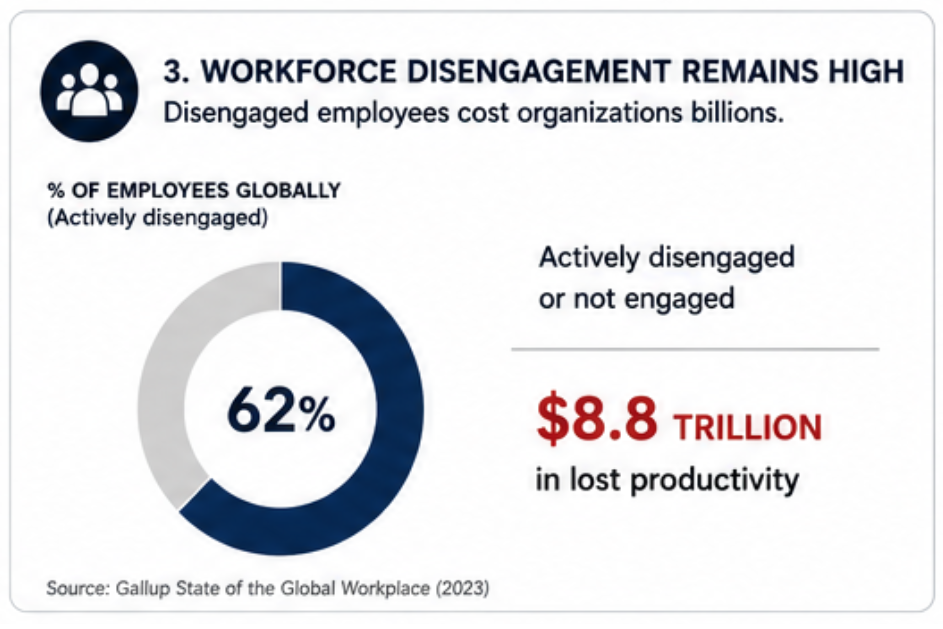
Gallup puts 62% of employees globally as actively disengaged or not engaged. That is $8.8 trillion in lost productivity. That number is not driven by one generation. It spans all of them. Which tells you something important: this is not an attitude problem or a values problem. Something structural is causing it.
Here is the structural cause. The average manager wastes 3.5 hours a day on flawed work systems. SOP breakdowns, digital tools that create friction instead of flow, bureaucracy with no real purpose, communication that goes in circles. When people spend that much of their day fighting a system that works against them, they stop caring about the system. That is a rational response to an irrational environment.
Dr. W. Edwards Deming made this point decades ago. When we see a performance problem, the instinct is to look at the person. But 94% of failures come from the system, not the worker. Disengagement is a performance problem. And if 94% of it comes from the system, then fixing the people is not the answer. Fixing the system is.
What we see in a Systems-Powered Organization is what happens when this gets addressed properly. When employees are working in systems that actually function, when their work creates tangible and visible results, when they can see that what they do matters, something changes. It is not a motivational program. It is not a new benefit. It is just people doing meaningful work in a system built to let them succeed. Every generation responds to that.
When every employee knows the work they are doing matters and sees the tangible return on their time and energy, that is what engagement actually looks like.
The engagement crisis is real. But it is not a mystery. People want to do good work. They want to contribute to something that is moving. When the system makes that possible, they show up. When it makes it impossible, they check out. That is human nature.