
Innovation + Strategy
The World Moved.
Did Your Inventing?
The fundamentals that made you great at this still work. The problem is the world you're applying them to looks nothing like it did.
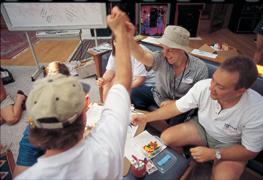
You remember what it felt like. The timer counting down. The stacks of yellow cards piling up. Someone across the table building on an idea you threw out two minutes ago, taking it somewhere you never would have gone alone. The excitement of thinking up something new and the pride of ownership when pitching to the room.
That feeling is real. And it still works exactly the same way.
What's different is the speed, depth, and discipline of how we do it now. And if you haven't been through a session recently, there's a good chance you're picturing the wrong thing entirely.
Most organizations used maybe 30% of what this system can actually do today.
The scope has changed
More Emphasis on Reinventing How Work Gets Done
New product inventing is absolutely a great application of Innovation Engineering and a priority for organizations looking for growth, but do not pigeon hole inventing to just new offerings.
One example was work with American Express, where one inventing session focused on a major new premium card concept built around benefits and experiences competitors couldn't match.
But some of the most important sessions were the less visible ones: inventing the systems behind the experience. How call centers would operate. How information would flow. How customer expectations would be exceeded. Basically how the work actually gets done.
Because increasingly, the breakthrough idea and the operating system behind the idea have to be invented together.
AI adoption is the latest trend in inventing challenges. Teams are moving past questions like "how do we use AI" as a technology and thinking about "how do we redesign the work around what AI makes possible." That's a systems level inventing problem. And it requires exactly the kind of structured, cross-functional, stimulus-driven thinking that brainstorming meetings will never produce.
Still undefeated
The Fundamentals That Haven't Moved
Forty years of inventing. These are the non-negotiable must haves.
Structured stimulus still beats thinking harder (aka brain drain)
Breakthrough ideas do not come from thin air or creative gurus. We use stimulus to disrupt thinking and force new connections. AKA Work smarter not harder.
Diverse thinking still beats isolated expertise
The strongest inventing teams still combine different perspectives (cross-functional employees, customers, technical experts, operators, and outside thinkers). Breakthrough ideas rarely come from one department thinking alone.
Drive Out Fear with Fail Fast, Fail Cheap learning cycles
Not avoiding failure. Outlearning everyone else. In a world moving at AI speed, this principle has never mattered more.
What actually changed
The Assumptions That No Longer Hold
Historically, inventing sessions were heavily focused on generating ideas and reducing Market Risk. That worked well, but many organizations still struggled later with Technology Risk and Organizational Risk once development actually began.
About 4% of ideas ultimately shipped. That isn't failure. It's the reality of innovation. The goal is stopping weak ideas before major investment happens.
Today, teams assess all three risks earlier. Concepts often get reinvented multiple times before the session even ends. The process is designed to build toward a clear Business Opportunity Recommendation so teams understand how real development decisions will get made.
What teams often experienced before
- Strong focus on idea generation and Market Risk
- Passion often drove early concept selection
- Technology and Organizational Risks explored later
- Sessions ended with excitement but unclear commitment
- Development decision criteria were often unknown
What stronger inventing systems do now
- All three risks assessed much earlier
- Concepts reinvented multiple times during the process
- Testing and learning built directly into sessions
- Business Opportunity Recommendations guide decisions
- Clearer path from inventing to real execution
The quiet revolution
The Room Got a Lot Bigger
The Jump Start Your Brain Platform changed the physics of who contributes. Getting people together in a room is great for building relationships, trust and staying engaged. But we will admit that it can also result in the loudest voices getting too much airtime, ideas disappeared into notebooks., partial thinking never got finished on a yellow card, and worst of all people who lived with the problem every day weren't in the conversation.
That's gone now. Teams build on each other's ideas in real time. Partial thinking gets captured. People contribute asynchronously. And the people who historically said the least are typing (inventing) the most.
The constraint was never creativity. It was a system that only heard from half the people who had something worth saying.
The thing nobody says out loud
Inventing Was Never Really About Ideas
This is the part that takes most people a moment to sit with. Every organization has ideas. Plenty of them. The problem is almost never a shortage of ideas. The problem is a shortage of teams aligned and energized enough to actually act.
Inventing is about creating an environment where teams think differently than they normally do inside the business. Different speed. Different psychology. Different conversations. The ideas are a byproduct of the environment and the system.
That environment is now more reachable, more scalable, and more applicable to more problems than it has ever been. AI. Systems redesign. Decision-making under pressure. Team alignment. Operational change. These are all inventing problems. They always were.
Most teams just didn't know they could use this for that.