
When You're Excited About Your Idea, That's Exactly When You Need a Blue Card
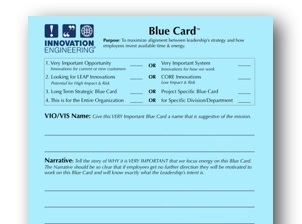
Most of the time, when working with clients, we start by coaching leadership on communicating their strategy. We capture that strategy using a one page format called a Blue Card. This way when we gather a team to invent ideas, we have clear objectives, focus areas and constraints. Then after inventing, the best ideas become projects and as those projects evolve we have the blue card to reference. If a project goes out of scope or fails to meet objectives we have a clear reason to stop.
A company recently came to us already holding the idea, excited and ready to run with it and wanted help with consumer testing and other aspects of the discovery phase. My advice was to take a small step backwards first. Write the Blue Card even for one project.
Knowing When to Stop
The temptation to skip this step if that you want to make progress. You want to learn what customer think, do the sales forecast, or prototype. But without a blue card, how do you know if the customer feedback is good enough? How do you know how much sales would be worthwhile? How do you know if a prototype is working well enough? It is better to be aligned on the decision criteria before starting then debating after getting results whether something is worth learning more, sopping or moving forward.
Every real idea hits a rough patch. Your mission is what keeps you motivated through it. And every idea tempts you to pivot or compromise somewhere along the way; without written boundaries, that pivot has nothing to check itself against. Constraints round it out by forcing you to admit, upfront, that you don't have infinite time or money.
Treat All Risk Equally
New ideas generally fail for one of three reasons: customers aren't interested (market risk), the product doesn't work (technology risk), or the idea is not aligned with the organization's goals (organizational risk). Teams tend to have more fear around the first 2, but organizational risk stops just about the same number of projects even when it's your company and your idea.
What a Blue Card Actually Captures
Strategic Mission
One sentence completing "We need ideas for ___." What keeps you motivated when it gets hard.
Strategic Exclusions
What you're explicitly not interested in. Your guardrail against a pivot becoming a different project.
Tactical Constraints
Budget, timeline, resources. Where you admit you don't have infinite runway, before you're six months in.
Narrative
The story of why this matters, clear enough that anyone reading it knows what to do.
Questions to Get a First Draft Down
More questions are available on Jump Start Your Brain, but here are some to get started.
- What's the real truth about why this matters to you or your organization?
- What are the reasons you are NOT pursuing this mission?
- What limitations in time, energy, money, and resources do you need to confront?
- What would have to be true for you to walk away from this idea?
For the company I mentioned earlier, I think they're in a good spot. The idea is meaningfully unique and has potential to bring in a new revenue stream to their business. Even my first instinct was to do math, because it seems like the price was too low to make money, but a higher price might not work with customers. But what they need first is alignment on what the math needs to be to make it worthwhile and not a distraction from their current business. With a Blue Card in place and a series of learning cycles, we can get to a kill or a green light in a matter of weeks. Without one, I could see this dragging on for another year with no real decision either way.
Look at Your Own System
Most project management systems I've seen all have the tactical features for managing who is doing what and when. But take a look at the project management system your team is using, and see if there's a spot that captures the mission, the exclusions, and the constraints before work begins. If there isn't, that's potentially where alignment problems spiral and a great opportunity for an improvement to your project systems.