Dynamic Pricing and Business Model Innovation
When you can't change the product, change how customers pay for it.
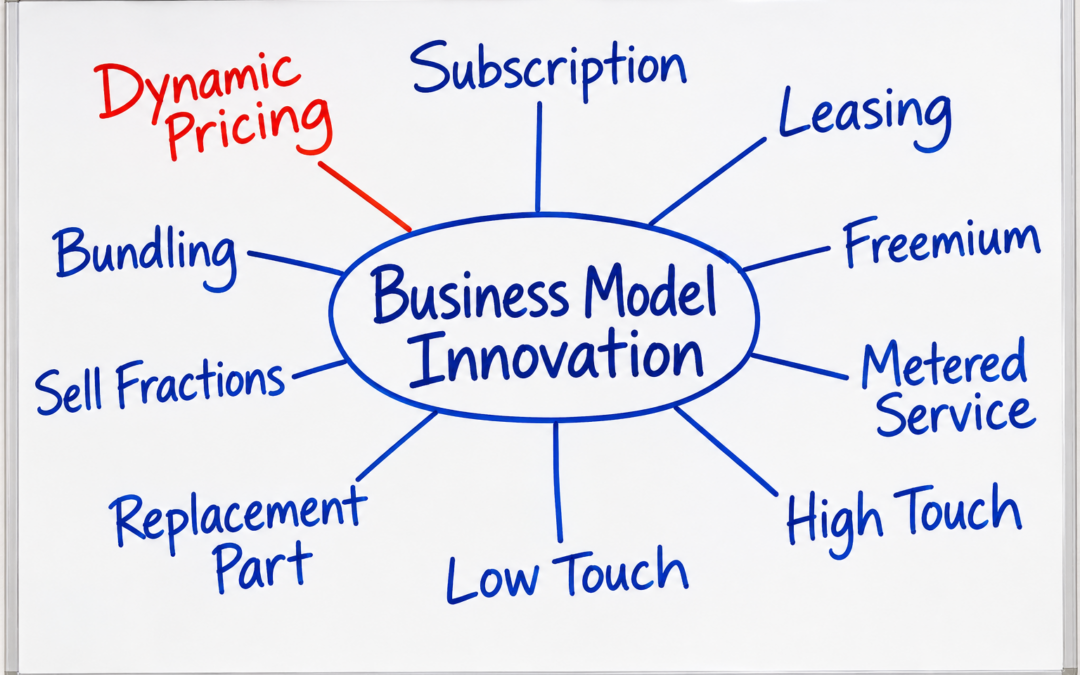
When working with teams who want to innovate and grow, but can't change the product, changing the business model is an option. By using other business models as stimulus, we can spark several ideas during during an inventing session.
Over the years, subscription models, for better or worse, have become more popular, really taking off around 2012 and not slowing down. Research and Markets estimates the global subscription economy at $738.82 billion in 2026, up from $623.61 billion in 2025, and projects it will reach $1.44 trillion by 2030. But that is just one model to use as stimulus.
Twelve ways to change how customers pay.
Randomly pick one and apply to your offering. Think about the benefit to you and your customers.
Wine of the Month
Tools & Equipment
eBay, Amazon
Electric Company
Skype
Costco, American Express
Razors/Blades, Computer Printers
Southwest, Walmart
Custom Homes
IBM
Timeshare Condo
McDonald’s Happy Meal with free toy
Dynamic pricing as stimulus.
The newest entry is dynamic pricing: the price of the same product moves with demand. It started with airlines, hotels, ride shares and concerts. Now it is moving into fast food and grocery shelves.
Looking at the events industry, you see the benefit for businesses. Ticketmaster says dynamic pricing helps keep scalpers and resellers from capturing more profits, so more of it goes to artists and promoters. That is good for them. But fans still pay higher prices, and critics say the practice simply moves more resale-level prices onto fans.
Customers are pushing back.
of UK adults dislike dynamic pricing.
like it.
want everyone to pay the same price.
say clear pricing matters to them.
HyperFinity survey of 2,000 UK adults, April 2026. The survey asked about grocery pricing.
The backlash reaches even companies that deny doing it. In recent weeks McDonald's pushed back on a Reuters report that it uses AI to set menu prices, and it now faces a class-action lawsuit over its pricing technology. Walmart published an open letter insisting "We price products, not people." Neither company says it uses dynamic pricing, but with technology available, you can see why customers worry anyway.
If your team is considering a price increase or any other kind of business model change, here are 3 insights to consider and increase your odds of success. .
Be upfront and honest.
When customers "perceive" that you are simply seeking extra profits, they immediately perceive it to be UNFAIR. The key to successfully changing a price or a pricing model is to give customers a real reason for the change. A real reason only helps if customers actually hear it.
Explaining a price increase can cut the perception of unfairness by 50 to 90%.
Doug Hall's research, Meaningful Marketing
You will realize DRAMATICALLY greater success with your pricing changes if you're upfront and honest with customers.
Be meaningfully different.
Cheap products are cheap products. Products that are of higher quality and that offer meaningful advantages usually cost more. If you're not meaningfully unique, you better be cheap. But on the flip side, if you are bold enough to invent something meaningfully unique to your customers, then you need to charge more. Customers will see this as fair and it allows you to profit more and reinvest in future innovation.
Customers look for "cues" to decide whether a price comparison is reasonable. The more you "look the same," "sound the same," "feel the same," the more likely they are to make the comparison. Do everything you can to make your offering look and feel different, such as bundling your options together into a luxury package as car companies do, or bundling an extended warranty or free installation with your offering.
Not joining in can be your point of difference.
If everyone else in your category is jumping on this dynamic pricing trend, then not doing it could be your point of difference.
One of the most important issues for customers is that they feel that they got the best price possible from you. If you have one price and only one price, with no price negotiations, customers may not like it but they feel satisfied that they didn't "overpay." Be direct about what value customers receive and what it costs, and give them confidence in the stability of your pricing.
Sources
- Jump Start Your Brain - Business Model Checklist
- Research and Markets, Subscription Economy Market Report, February 2026
- IT Brief UK, on the HyperFinity survey of 2,000 UK adults, April 29, 2026
- Retail Brew, "Walmart, McDonald's push back against dynamic pricing fears," October 13, 2026
- The Shelby Report, on Walmart's open letter, October 6, 2026
- Raleigh Magazine, on dynamic pricing for concert tickets, March 27, 2026
- Doug Hall, Meaningful Marketing