
Innovation + Cost Estimation
Why Your Best Innovation Idea Is Probably Going to Cost Twice as Much and Take Three Times as Long
Optimism bias is baked into how innovators think. New AI estimation tools can help, but they bring their own blind spots.
You have just had the idea. You can feel it. When you sketch out the timeline it looks almost manageable. Six months. Maybe eight. Budget? Call it $500K. Done. Then reality arrives.
If this sounds familiar, you are not alone and not uniquely bad at planning. You are human, and being human comes with a factory-installed cognitive feature called optimism bias that has been quietly sabotaging innovation budgets for centuries.
The Two-Sided Problem
First, we overestimate the value of our idea. The new product will capture the market faster than expected. The process redesign will deliver bigger savings. We genuinely believe it, which is precisely what makes it a bias rather than a lie. Second, we underestimate the cost. We anchor on best-case scenarios, not accounting for rework loops, vendor delays, and the scope creep that every real project encounters.
Put these two together and you have created the perfect conditions for a project that looks brilliant on paper and becomes a scramble in execution.
Nobel Prize winner Daniel Kahneman spent decades documenting the planning fallacy. Construction megaprojects routinely come in at 2x their original budget. New product launches routinely underperform first-year revenue projections. Knowing this does not make the bias disappear, but it does make better estimation tools a competitive necessity rather than a luxury.
A History of Building Guardrails Against Ourselves
"The history of cost estimation is really a history of humans trying to build guardrails against their own optimism."
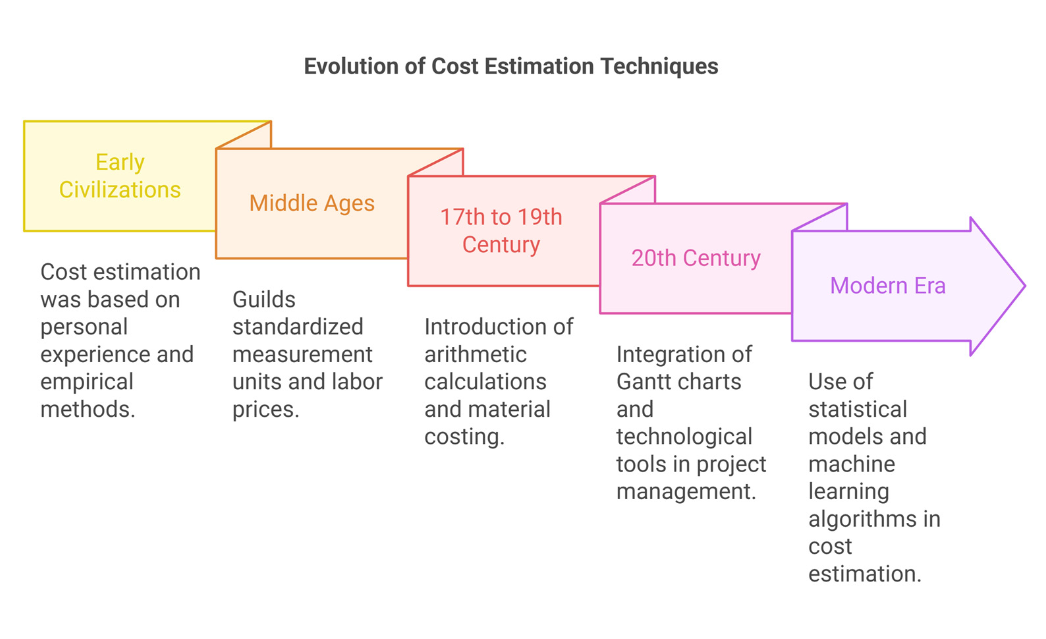
Eureka! RanchEarly builders estimated through pure experience and rule of thumb. More formalized approaches emerged: analogous estimation (borrowing from comparable past projects), parametric estimation (building statistical relationships between variables and cost), and bottom-up estimation (pricing out every task in a work breakdown structure).
Each method was better than gut feel alone, and each still left room for human bias to sneak back in through the assumptions. Then came machine learning, and suddenly the guardrails got considerably more sophisticated.
What the Research Actually Shows
A 2025 systematic review in Modelling (Shamim et al.) synthesized findings from 39 high-quality studies published between 2016 and 2024, examining AI model performance in cost estimation across construction, healthcare, manufacturing, real estate, and beyond.
The broad finding: AI-driven models consistently outperform traditional methods in predictive accuracy and ability to handle complex, nonlinear relationships between variables. Artificial neural networks alone made up 26% of all studied approaches, reflecting how dominant deep learning has become as a default tool for this problem.
Industries studied
Building construction Road construction Healthcare Manufacturing Real estate Mining Aviation Highway construction Software Bridge construction Canal irrigationDeep learning
ANNs proved remarkably flexible: road construction (86%), mining capital costs (92%), and building projects reaching 99% in several studies. Long Short-Term Memory networks shone in time-series forecasting, predicting construction cost indices with more than 99% accuracy. If your project spans years in a volatile market, this matters.
Machine learning
XGBoost emerged as a standout, achieving 90% for conceptual construction costs and 96% for green building prediction. Support Vector Machines reached 97.56% for forest road construction. Random Forest performed well in healthcare where nonlinear patient variable interactions make simple regression inadequate.
Hybrid models
Combining methods often produced the best results. A hybrid LGBoost-NGBoost model achieved 95% for early-stage building construction. A CBR-ANN hybrid reached 94% for manufacturing cost prediction in new product development, directly relevant to innovation work where projects rarely fit a single clean category.
| Model type | Accuracy range | Best suited for |
|---|---|---|
| Deep learning (ANN, LSTM, DNN) | Complex nonlinear data, large historical datasets | |
| Machine learning (XGBoost, SVM, RF) | Construction, healthcare, green building | |
| Regression (GPR, GBR, quadratic) | Simpler relationships, interpretability a priority | |
| Hybrid (XGBoost-RF, CBR-ANN, PCA-ANN) | Complex, multi-faceted innovation projects |
Top accuracy scores
Innovation-relevant scores
A Warning Before You Run the Model
Adopting machine learning for cost estimation is not just a technical upgrade. It is a paradigm shift in how you think about projects, and that shift carries real risks if you are not paying attention to them.
You need more data than you think
Many high-performing models relied on thousands of data points. Organizations estimating genuinely novel innovations may not have enough historical data to train models reliably. Garbage in, confident garbage out.
The black box problem is real
Deep learning models can be extraordinarily accurate and nearly impossible to explain. If leadership cannot understand why the model says $2.3M instead of $1.8M, adoption will stall, and it should, because unexplainable models create their own category of risk.
Precision creates false confidence
A model outputting $1,847,234 feels more credible than "roughly $1.8 to $2.2M." That precision can mask significant uncertainty. Always ask for confidence intervals, not just point estimates. Several studies in the review flagged the absence of uncertainty quantification as a key limitation.
Models reflect the past
Your innovation is about the future. AI models learn from historical data. If you are building something without real predecessors, the model has nothing to calibrate against. And when teams know their estimates feed into a model, they tend to adjust how they report data, which can distort the dataset over time.
Calibration Tool, Not Crystal Ball
Used well, these models help your team answer the right questions: Are our estimates consistent with what comparable projects have historically cost? Which variables are driving cost most? How sensitive is the estimate to changes in labor rates or material prices?
The goal is not to replace human judgment. It is to make human judgment better informed.
The best innovation teams use AI estimation tools to stress-test assumptions, surface variables they had not fully considered, and build in the honest uncertainty ranges that optimism bias tends to flatten out. Your idea might still be great. What these tools can do is help you resource it honestly, plan for the real world rather than the best-case world, and give your organization a fighting chance at delivering on what you promised.
Eureka! Ranch helps organizations build the skills, systems, and culture needed to turn bold ideas into real results. When the math matters as much as the magic, we are here for both.