
How Innovation Engineering Applies to People, Not Just Ideas
Innovation Engineering is often associated with new products, bold ideas, and measurable growth.
But its deepest impact is not on ideas.
It is on people.
Impacting how managers lead. Impacting how teams engage. Impacting how relationships function under pressure.
When Work Feels Harder Than It Should
Leaders blame effort and workers. The real culprit is system design.
Not enough accountability. Not enough ownership. Not enough discipline.
Yet in many organizations, talented people are working inside systems that create friction.
Priorities shift without clarity. Decisions stall without criteria. Meetings multiply without resolution.
Research shows the average manager wastes 3.5 hours per day dealing with broken systems, unclear priorities, and ineffective meetings.
Over time, engagement drops not because people care less, but because the system drains energy faster than it creates progress.
Innovation Engineering addresses the design of work itself. Because as Dr. W. Edwards Deming said, “94% of failures are due to the work system, 6% are due to the workers.”
If you fix the system and you change the emotional climate of work.
And this changes shows up in measurable results. Organizations that engage every employee in proactive problem solving often see dramatic productivity gains within 100 days.
Clarity Strengthens Relationships
Ambiguity creates tension between roles.
What would change if every meeting had clear context, clear ownership, clear exploration areas, clear boundaries, and most importantly clear purpose?
When expectations are unclear, conversations become emotional. People defend opinions instead of examining evidence.
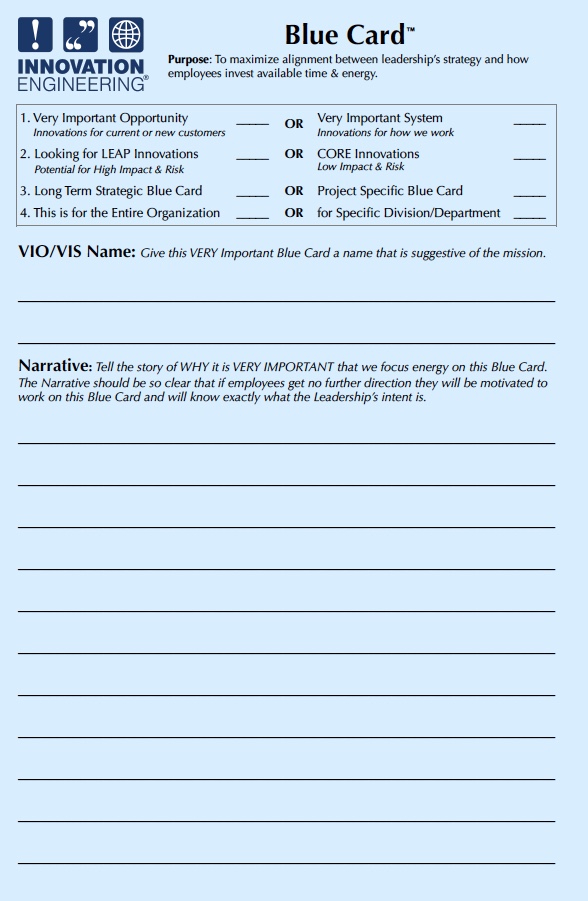
Structured framing tools bring clarity to strategy and ideas. Strategy drives alignment for what ideas we need. Then the ideas clearly state the problem is being solved, what success looks like, and what assumptions are being tested.
When clarity increases, conflict decreases. Conversations shift from personalities to data.
Engagement Rises When People Improve What They Touch
In the Proactive Problem Solving research, a consistent pattern emerges.
Engagement increases when individuals are invited to improve the systems around their work, not just execute within them.
A simple question often unlocks momentum: "What is getting in the way of you doing great work?"
When leaders listen and act on system barriers, employees shift from compliance to contribution. And then when every employee is trained to improve what they touch, cost savings can multiply far beyond what experts alone can deliver.
Roles Become Clearer
Many cross functional tensions are not personality conflicts. They are design conflicts.
When evaluation criteria are vague, departments compete. When decision authority is unclear, progress slows.
Innovation Engineering introduces transparent evaluation, visible assumptions, and disciplined learning cycles.
Instead of asking who owns the answer, teams ask what the data says and what test should run next.
The result is not just better ideas. It is healthier interaction between roles.
Managers Become Coaches
In reactive systems, managers spend their time correcting errors and resolving friction.
In proactive systems, managers focus on improving the design that prevents recurring problems.
Conversations move from blame to experimentation.
From urgency to evidence.
From control to coaching.
This shift changes the emotional tone of leadership.
A Human System
Innovation Engineering is not primarily about generating more ideas.
It is about designing work so that intelligence compounds, relationships strengthen, and engagement becomes sustainable.
When the system improves, people thrive inside it.
MISSION: To change the world by ENABLING INNOVATION by Everyone, Everywhere, Every Day
Resulting in Increased Speed to Market (up to 6X) and Decreased Risk (30 to 80%)
3849 Edwards Road, Cincinnati, Ohio 45244 USA • +1 (513) 271-9911
©, ® &/or Patentable Technology used under license from Eureka! Institute, Inc.