
Build a High-Performing Innovation System
Innovate up to 6X faster, with 30–80% less risk, and ideas that grow in value instead of losing it, by replacing guesswork with a proven system.
Schedule a CallWe meet you where you're at.
You do not have to blow up what already works. We take your current systems and bring in our best practices at a pace that builds real adoption, not a pace that just checks a box for leadership.
Here is the real benefit, and it is the whole point of this page. A system by itself does not do much. The benefit shows up when you add people who are genuinely working to make that system better, rather than people simply running it the same way year after year. A system plus people committed to improving it, that combination is what creates never ending improvement. It compounds in a way a one time workshop or a single point solution never will.
Here is what that looks like once it is actually running inside an organization.
More value. More speed. Less risk.
Our systems-driven innovation approach, Innovation Engineering, is built to move all three numbers at once, not trade one for another.
Most ideas lose value on the way to launch. Ours gain it.
In a typical stage-gate process, every review is a chance for an idea to get watered down, compromised, or quietly killed. Our system is built to do the opposite.
Typical Innovation System
Ideas get subverted at each review to survive the process. By the time a project reaches development, it's lost more than half of what made it worth doing.
Innovation Engineering
When something isn't possible, the team learns more and pivots instead of compromising. Ideas grow through discovery instead of shrinking through negotiation.
A system built to be fast, visible, and honest about what it's learning.
Speed and lower risk don't come from moving faster and hoping. They come from specific, deliberate design choices inside the system itself.
Fast, Cheap Research
Research is built to be fast and inexpensive, so teams can test more with real customers and stakeholders, and let data, not opinion, inform decisions.
Alignment That Stops Drift
Project management systems maintain alignment to business priorities. If a project pivots away from what matters, it stops, instead of quietly consuming resources.
Cycles of Learning, Not Compromise
When something isn't possible, the team learns more and pivots rather than watering down the idea to make it fit. That's how value grows instead of shrinks.
Clear Project Roles
Everyone on the project knows what they own, so decisions don't stall waiting for someone to step up or someone else to step back.
Checklists That Make the System Visible
Project checklists make the system visible to everyone involved, so progress and gaps are obvious rather than hidden in someone's head.
Creativity Tools Throughout
Creative tools show up at every stage of the system, not just at the beginning, because good ideas are still needed when a project hits a wall in month four.
Define. Discover. Develop. Deliver.
This is the backbone we build from, not a rigid pipeline we force onto every organization. The specific stages, gates, and language always get shaped around how your business actually works.
No two organizations run this the same way. A manufacturer's "Discover" phase looks different from a software team's, and that's the point. We customize the gates, checklists, and roles to your business instead of handing you a generic template.
Method beats guessing, and the data shows it.
The Three Laws of Marketing Physics are part of what the system builds into every project, and the success-rate lift from each one is measurable.
Marketing speaks in problem and promise. R&D speaks in features and proof. Both groups are right, and both are talking past each other, because customers do not actually buy either language on its own. Customers care about what makes you better than everyone else.
That is why we use Yellow Cards. A Yellow Card gives everyone on a team, marketing, R&D, sales, and ops alike, one standard way to write an idea down as a customer opportunity to win, instead of a feature list or a slogan. It puts problem, promise, and proof on the same page, literally.
Overt Benefit
Real Reason to Believe
Dramatic Difference
Training people to write a sharp Yellow Card, and giving them the communication tools to back it up, is one of the fastest ways we see idea quality go up and risk go down.
72 rounds of testing. In a week.

Edrington Group needed to accelerate how fast they could get real answers from real drinkers. Instead of the slow, traditional research cycle, we compressed the process into 72 rounds of testing in a single week, getting more learning, faster, than a typical quarter of research would produce.
But the bigger win wasn't the one fast week. It was what came after: we worked with Edrington to turn that approach into a repeatable system their own team could run every weekend at bars, testing continuously instead of waiting for the next big research cycle to roll around.
From red, yellow, green to an actual probability of success.
Most companies rate innovation risk with a stoplight. Red, yellow, green. It feels useful in the room, but it does not actually tell you much. Two projects can both land on yellow and have wildly different real odds of success.
We worked with a company to build something better: their own risk assessment model, grounded in their own historical data, using the Delphi approach to turn individual team estimates into one grounded probability of success instead of a color.
That system has now assessed their ideas for six years running. Engagement with it has grown across departments the entire time, because people trust a number they understand more than a color they do not. The result is better collaboration, more transparency, and a lot less guessing.
Why a small change can take a year, and what to do about it.
A food manufacturer started using our platform for their big new product launches, the kind of projects that get leadership's full attention. But they also started running their small, incremental changes through the same system.
That is where it got interesting. Running the little changes through a visible system showed them something they had never actually seen before: why even a small change could take an entire year to ship. The bottlenecks, the handoffs, the approvals that did not need to happen at all, it was sitting right there in plain sight for the first time.
From there, they used the process to assign clear roles, train new people coming onto the team, and set deadlines based on how the work actually happens, instead of deadlines based on what leadership hoped would happen.
A system only works if your people can run it.
We train the people who will actually lead innovation projects and run the innovation system day to day, not just a few specialists off in a corner. That means they know how to fill the pipeline and move ideas forward with confidence.
But the bigger win is what happens after that: trained people don't just run the system, they improve it. They spot where a process is slowing them down, where a gate doesn't make sense for their part of the business, and they fix it, which is exactly how the system keeps getting faster and smarter over time instead of calcifying into one more framework nobody touches.
Lead Projects
Trained to run ideas through the system with real tools, not just enthusiasm.
Fill the Pipeline
Equipped to keep new ideas moving in, not just manage the ones already in motion.
Improve the System Itself
The real goal: people who make the process better, not just people who follow it.
Build a High-Performing Innovation System
The only end-to-end innovation system that combines a proven methodology, trained people, real-world application, and technology to make innovation faster and more predictable.
For established organizations that have invested in innovation but need their people, processes, tools, research, and decisions to work together more effectively: innovation programs often depend on a handful of experts, isolated workshops, or disconnected tools. People may know innovation matters, but lack the common skills, processes, evidence, and infrastructure to consistently turn uncertainty into better decisions and successful outcomes.
We enable your organization to innovate at 6X the speed with 30–80% less risk, while building the internal capability to keep improving innovation performance over time.
Eureka! Ranch created Innovation Engineering to provide the principles and skills required to consistently create, communicate, and commercialize innovation. We then enable the organization through training, real-world application, and customization of the Jump Start Your Brain platform. The system gives people common methods for generating ideas, testing assumptions, gathering customer evidence, forecasting outcomes, communicating concepts, and making faster decisions. Instead of teaching innovation as an event, we build the capability into how your organization works.
Here is the part most companies do not want to hear.
Results are driven by your system. Not your people's effort. Not their intentions. Your system. And here is the uncomfortable math behind that: the average innovation system produces zero new products over three years. Zero.
To actually grow, a company needs roughly a third of its sales to come from offerings it did not sell three years ago. Do that math against a system producing nothing new, and you can see where this goes. You are not growing. You are coasting on what you already built, and that clock runs faster than most leaders think.
This is not a hunch. The U.S. Bureau of Labor Statistics tracks new groups of businesses every year through its Business Employment Dynamics program. Over the ten years from 2013 to 2023, only 34.7% of businesses were still operating. Manufacturing did a little better, at 43.6%. Look at those numbers again. Most businesses do not make it.
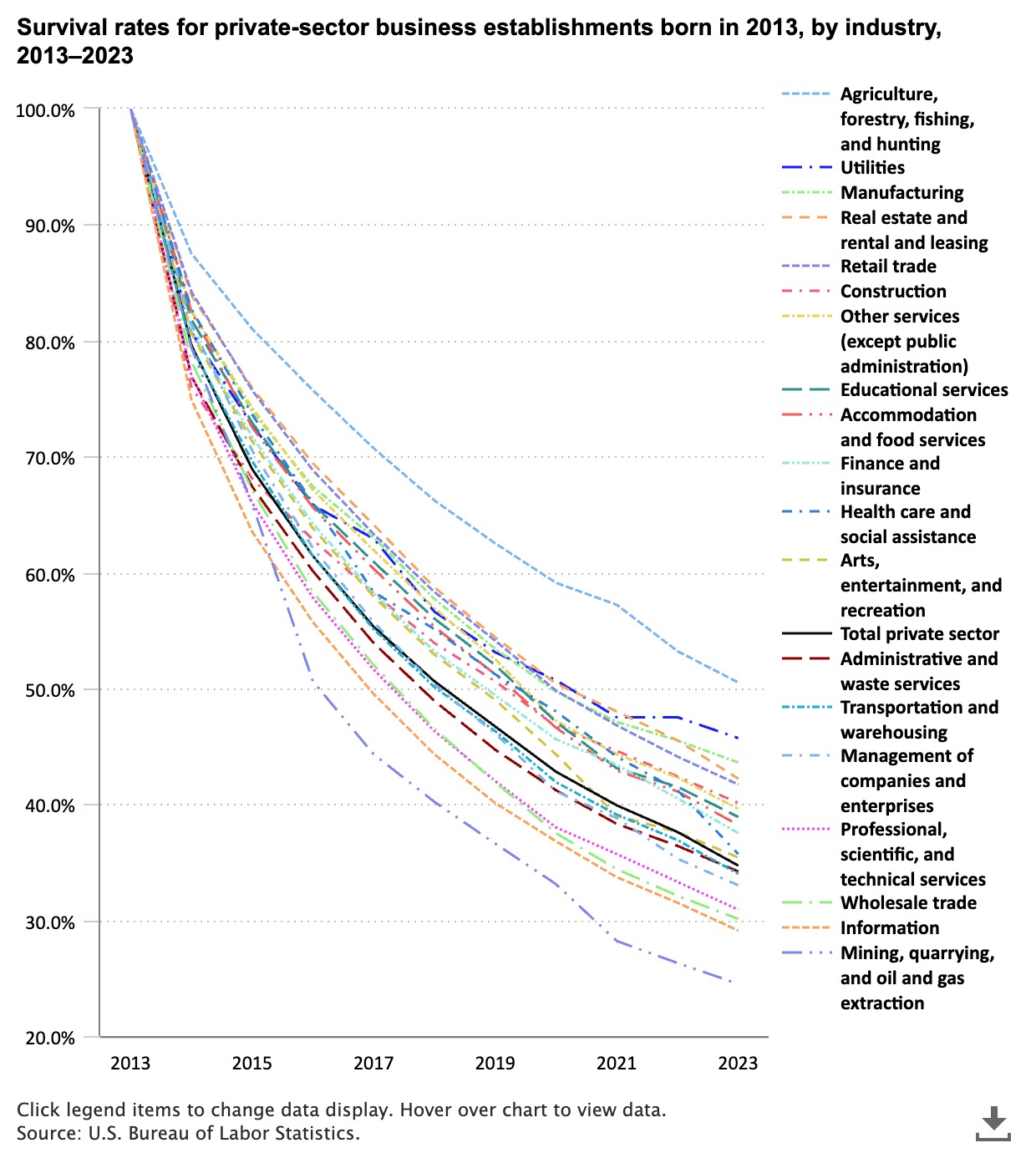
This is the world we live in. It is not changing. You cannot vote it away, wish it away, or outwork it away on willpower alone. But you can change. You cannot be average and expect to win. You need to be in the top third, and if you really want to feel it, the top fifth.
We love helping companies grow and make more money. That is good work. But I will tell you what feels even better: keeping a company in business, and preserving or creating the jobs that come with it.
If you do nothing, expect the same results you are already getting. If you want something different, change your systems for innovation.
One call. Then we pick the right starting point together.
A Quick Call
No pitch, no deck. We get to know each other, talk through your goals, and get a real read on your urgency, because that changes where we start.
From there, there are two ways in. Both work. Which one makes sense depends on your situation.
Train Your People
We train your people to lead innovation projects and run the system themselves. It takes a bit more upfront investment, but it is how you build lasting, organization-wide capability instead of leaning on us for every single project.
Start With a System Map
We come in as consultants and map your current innovation system first. It is a less disruptive way to get a quick win on the board and build momentum, before you decide how far to take it.
Either path gets you moving. Which one makes sense for you depends on where you are right now, and that is exactly what the call is for.
More value, more speed, less risk, starting with one project.
Let's talk about what a high-performing innovation system would look like inside your organization.
Schedule a Call